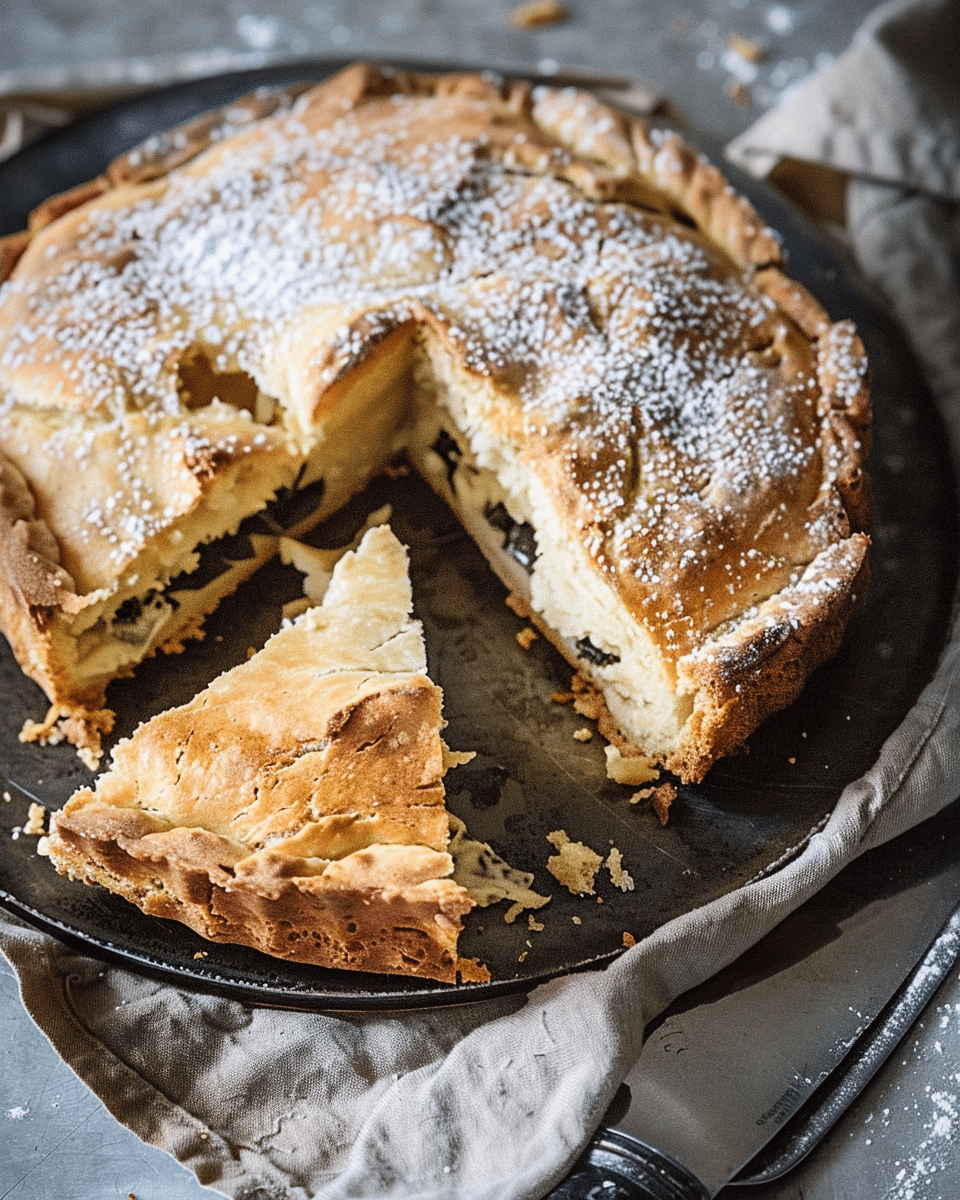
I appreciate this recipe because it uses everyday ingredients and transforms them into a satisfying, traditional dish. I like the richness that lard adds to both the filling and the pastry, and I enjoy how the Parmigiano-Reggiano enhances the greens with its salty depth. I also love that this pie tastes just as good at room temperature as it does warm from the oven.
Ingredients
(Note: All ingredient amounts are listed in the recipe card below.)
For the stuffing 1 kg (2.2 lbs) chard 2 cloves (2 cloves) garlic 1 (1) onion 130 g (1.15 cups) Parmigiano-Reggiano cheese 60 g (4.06 tbsp) lard q.s. (q.s.) salt q.s. (q.s.) pepper
For the pastry 200 g (1.6 cups) flour 100 ml (0.42 cups) warm water 40 g (2.71 tbsp) lard q.s. (q.s.) salt
Equipment 1 Aa rectangular pan measuring approximately 25 × 35 cm
Directions
I start by cleaning and washing the chard, then blanching it briefly and chopping it coarsely.
In a pan over high heat, I melt part of the lard and add the onion sliced into thin strips along with the peeled garlic cloves.
Once the onions and garlic are browned, I add the chard, salt, and pepper, lower the heat, and let everything simmer for a few minutes.
I remove the garlic and let the mixture cool before adding the grated Parmigiano-Reggiano. I adjust the seasoning if needed.
To prepare the pastry, I sift the flour into a large bowl, then add the salt and lard and begin kneading.
I add the warm water a little at a time, kneading until the dough becomes soft and elastic. I cover the bowl and let the dough rest for half an hour at room temperature.
I prepare the baking mold by lining it with parchment paper or lightly greasing it with olive oil.
Once the dough has rested, I divide it into two equal parts. I roll one part very thinly so that it is wider and longer than the baking dish.
I place the rolled dough into the mold, letting it fall over the edges. I spread the chard mixture evenly inside.
I roll out the second half of the dough even thinner than the first and slightly wider than the mold, then lay it on top to cover the filling completely.
I fold and press the edges of the two dough sheets together, trimming any excess with a knife. I pierce the top with a fork to create small air holes.
I preheat the oven to 400°F and bake the erbazzone for 30 minutes. For a convection oven, I reduce the temperature to 350°F and bake for 20 minutes. I watch for a crisp, golden surface before removing it.
I take the erbazzone out of the oven, spread a thin coating of lard over the top, and bake it for a few minutes more. Then I remove it and let it cool.
Servings and Timing
This recipe serves 4 people. Prep Time: 30 minutes Cook Time: 30 minutes Total Time: 1 hour 30 minutes
Variations
I sometimes replace part of the chard with spinach when I want a milder flavor. When I want a lighter version, I replace the lard in the pastry with olive oil, though I lose a bit of the traditional richness. A pinch of nutmeg in the filling is another variation I enjoy.
Storage/Reheating
I store erbazzone in an airtight container in the refrigerator for up to three days. I reheat it in the oven so the crust stays crisp, though it also tastes great at room temperature. I avoid microwaving it because the pastry softens too much.
FAQs
Can I use spinach instead of chard?
Yes, I often use spinach for part or all of the greens when I want a softer flavor.
Is lard essential for authenticity?
Traditional erbazzone uses lard, and I prefer it for flavor, but I can substitute olive oil.
Can I make the pastry ahead of time?
Yes, I prepare the dough a few hours early and keep it covered until ready to roll.
Why is my crust tough?
I make sure not to overwork the dough and to let it rest properly before rolling.
Can I freeze erbazzone?
I freeze it after baking and reheat it in the oven to restore crispness.
What cheese works best?
Parmigiano-Reggiano is traditional and gives the best flavor.
Can I add other vegetables?
Yes, I sometimes add sautéed leeks or onions for extra sweetness.
How thin should I roll the dough?
I roll it just a few millimeters thick for the top and slightly thicker for the bottom.
Do I need to squeeze the chard?
Yes, removing excess water helps keep the filling from becoming watery.
Can I serve it cold?
Yes, I enjoy erbazzone warm, room temperature, or cold.
Conclusion
I find erbazzone to be a wonderfully rustic and satisfying savory pie, full of earthy greens and rich cheese wrapped in a crisp, delicate crust. I love serving it as a snack, appetizer, or light meal, and it never fails to bring the comforting flavors of Emilia-Romagna to my table.
A rustic savory pie from Emilia-Romagna made with a crisp lard-enriched pastry filled with sautéed chard, garlic, onions, and Parmigiano-Reggiano for a hearty, traditional flavor.
Ingredients
For the stuffing:
1 kg chard
2 cloves garlic
1 onion
130 g Parmigiano-Reggiano, grated
60 g lard
Salt, to taste
Pepper, to taste
For the pastry:
200 g flour
100 ml warm water
40 g lard
Salt, to taste
Instructions
Clean and wash the chard, blanch briefly, and chop coarsely.
In a pan over high heat, melt part of the lard. Add sliced onion and peeled garlic cloves.
When browned, add chard, salt, and pepper. Lower heat and cook for a few minutes.
Remove garlic and let the mixture cool. Add grated Parmigiano-Reggiano and adjust seasoning.
To prepare the pastry, sift flour into a bowl. Add salt and lard, then knead.
Add warm water gradually and knead until soft and elastic. Cover and rest 30 minutes.
Prepare the baking pan by lining with parchment or lightly greasing.
Divide dough into two parts. Roll one part thinly, wider than the baking dish, and place it inside.
Add the chard filling and spread evenly.
Roll the second dough portion even thinner and wider, then lay it on top.
Seal edges, trim excess, and pierce the top with a fork.
Bake at 400°F for 30 minutes (or 350°F convection for 20 minutes) until golden and crisp.
Spread a thin coating of lard on top and bake a few minutes more. Cool before serving.
Notes
Replace part of the chard with spinach for a milder flavor.